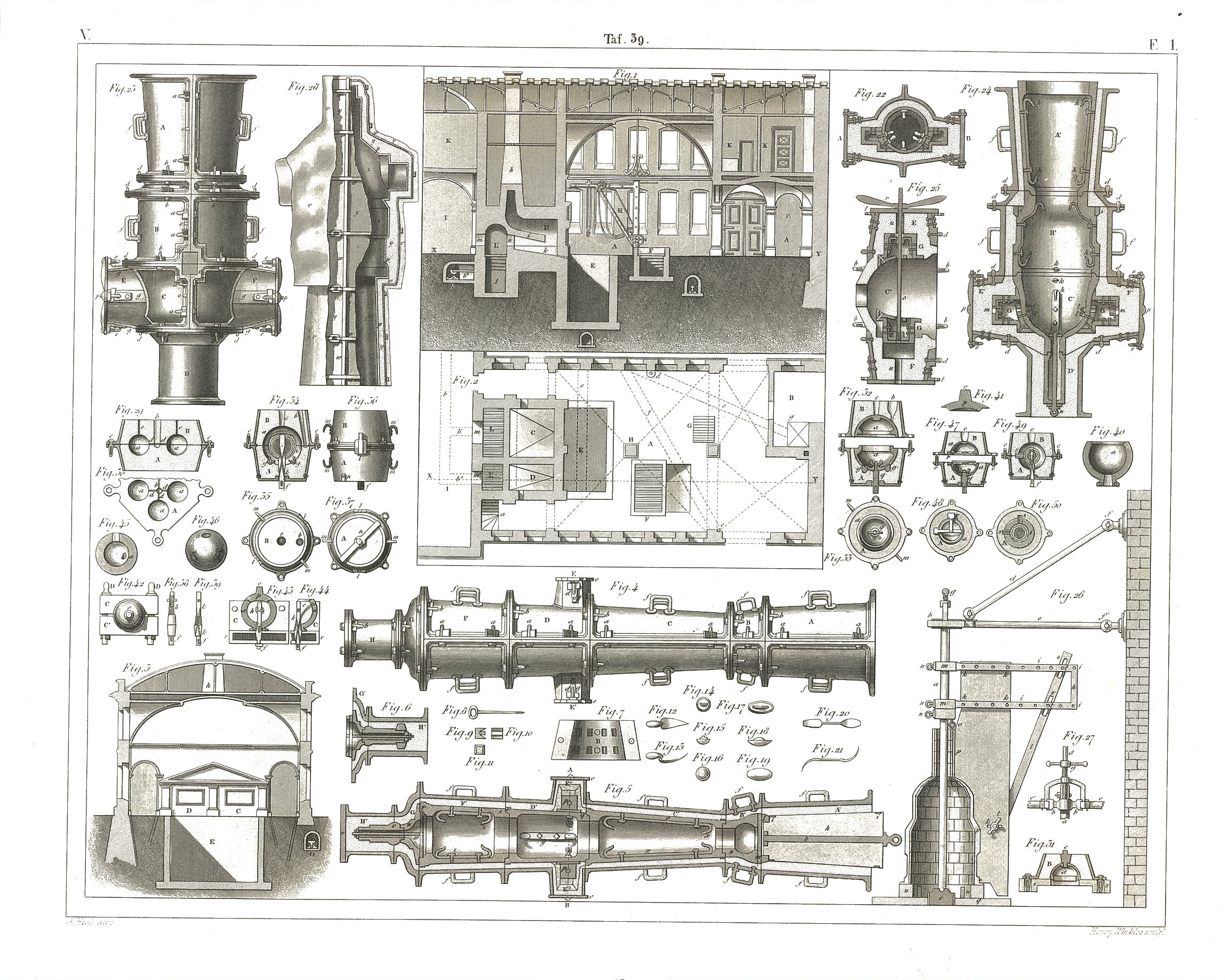
| Shows loam moldings, dry sand moldings, the process of the foundry and the casting of cannon and projectiles. A steel engraving from 1844, published by Johann Georg Heck. Fig. 1. Longitudinal section of a canon foundry, 2. Plan of the same, 3. Cross-section of the same, 4. Mold boxes (dry sand molding), 5. Section of a molded 6-pounder gun, 7. Depressions in the internal walls of molding, 9-11. Ears of the mold box, 12-13. Little trowels, 14-16. Small disks, 17-19. Larger oval disks, 20-21. Spatulas, 22. Cross section of mold, 23. View of completed mold of 50-pound mortar, 24. Section of 50-pound mortar, 25. Cross-sections through the trunnions, 26. Molding for a 50-pound mortar, 27. Upper end of molding, 28. Completed mold, 29. Two boxes standing one upon the other, 30. One part of a mold box for four 6-pound balls, 31. Manner of molding, 32. Two mold boxes for a shell or bomb, 34. Perpendicular section of both mold boxes, 35. Upper view of finished mold, 36. Side view, 37. Under vies of finished mold, 38. View and 39. Section of a core spindle, 40. Sand cores, 41. Cap, 42-22. Upper view, profile and cross-section of a molding bench), 45. Section and 46. View of a fire bomb, 47. Two mold boxes, 48. Upper view of the lower mold box, 49. Vertical section of both mold boxes, 50. Lower mold box. |