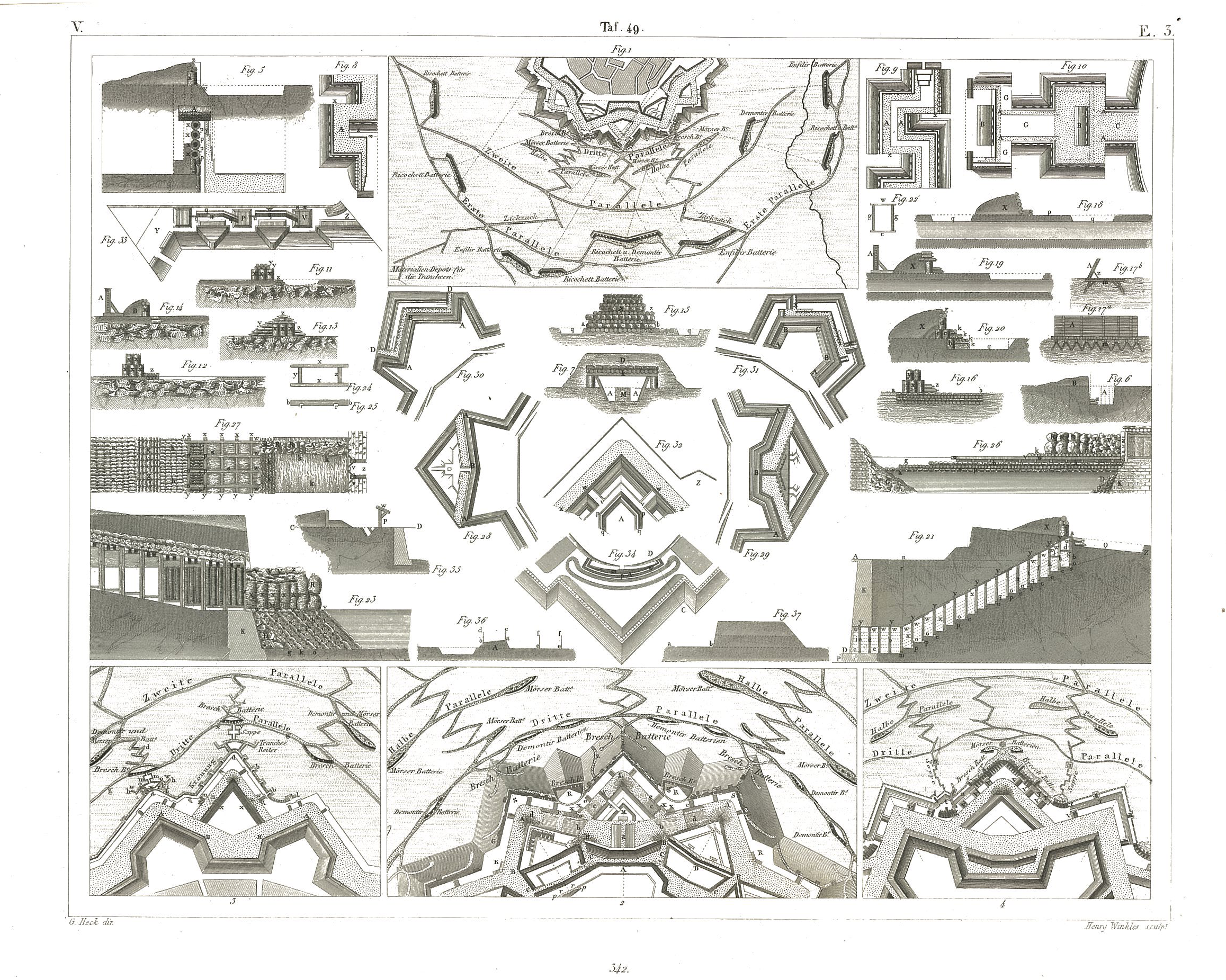
| Steel engraving, 1844, published by Johann Georg Heck. If a fortress is to be formally invested, it is first surrounded, to cut off all succor and assistance, with a line of circumvallation, established at about two miles distant, and constructed according to the rules of fortification; or at least all roads running to the place are taken possession of, and all the adjacent villages and important localities. At the same time, depots for artillery and siege material, magazines, &c, are established. From this line of circumvallation, or from the occupied points, approaches are now made, by means of ditches of communication (boyaux), upon the prolongation of the capitals of the front destined to attack (pi. 49, fig. 1), which ditches run in zigzag, so as not to be enfiladed from the place. When within 1800 feet of the fortress, that is, near the foot of the glacis, a trench is established, the first parallel, which surrounds the whole front to be attacked. The first parallel serves as a place of assemblage for artillery and infantry, and for the location of those batteries from which curved fires are to be given, that is, for the enfilade and ricochet, and for the mortar batteries. These batteries should enfilade, not only the long lines of the front attacked, but also the curtains of the adjacent fronts. Not to interfere with the communications, the batteries are established, not in, but before or behind the parallel. From the first parallel approaches are again continued by boyaux in zigzag still upon the lines of the capitals, until a distance of about 900 feet from the covered-way is attained, when the second parallel is established, which, as well as the first, must be secured from attack at the extremities. In this parallel, which serves properly only as a place for rest and assemblage, batteries are seldom established, at most some elevated counter-batteries, and especially mortar batteries. Still approaching, by means of the boyaux (pi. 49, fig. 3dd), the third parallel, gg, is established near the salients of the covered-way, and in this are placed the counter-batteries, x. Between the second and third parallels, a half parallel is usually established (figs. 2 and 4), which encloses the bastion of the attacked front, and serves to cover the further advance of the boyaux by a fire of small arms, or to attack with the fire of artillery points which could not be properly reached from the second parallel. |